
Kitchen renovations · GTA
Two GTA kitchen companies, side by side — who builds the cabinets, whose team is in your home, and what each publishes about warranty, timelines and pricing.
Complete kitchens from $20,000
Free in-home measure. No fee, no obligation.


A Toronto factory-direct shop where the showroom is the factory floor. We found nothing published on whose team does the work, warranty, insurance and certificates, stated timelines, published pricing, financing or reviews they show, so the table records that rather than assuming an answer. We build our cabinets ourselves in Woodbridge, do the trades with our own certified team, and back the work with a five-year warranty on labour and materials plus a lifetime cabinet warranty.
Price your kitchen in 90 seconds How we work, start to finish
Everything stated about Impressions Kitchens comes from their own published website, checked August 2026. Where we could not find a claim, it says so rather than assuming its absence.
Built for complete renovations
We work with homeowners who want one team to plan and finish the whole kitchen — not to coordinate a cabinet supplier, a countertop shop and an installer themselves.
Cabinetry, countertops and backsplash are all included when we renovate a kitchen — we just don’t sell them separately. Refacing, wrapping and repainting are different: that’s our cabinet-refresh service.
No fee and no obligation at any point before you have a written quote.


The showroom is in Mississauga and the cabinets are built in Woodbridge, but the crews work well past the GTA — Collingwood and Barrie to the north, out to Peterborough and Cobourg in the east, Kitchener and Brantford to the west, and down through Hamilton to Niagara.
Further out across the GTA depending on the size of the project — put your postal code in and we’ll tell you.
Has its own page - tap the pinWithin our service areaHover a town and the van drives there from the showroom.
Most people renovate a kitchen once or twice in their life, so nearly everything about the process is unfamiliar the first time — what the work actually covers, what order it happens in, and which decisions are expensive to change later. Here is the honest version, from kitchens we have built across the Greater Toronto Area.
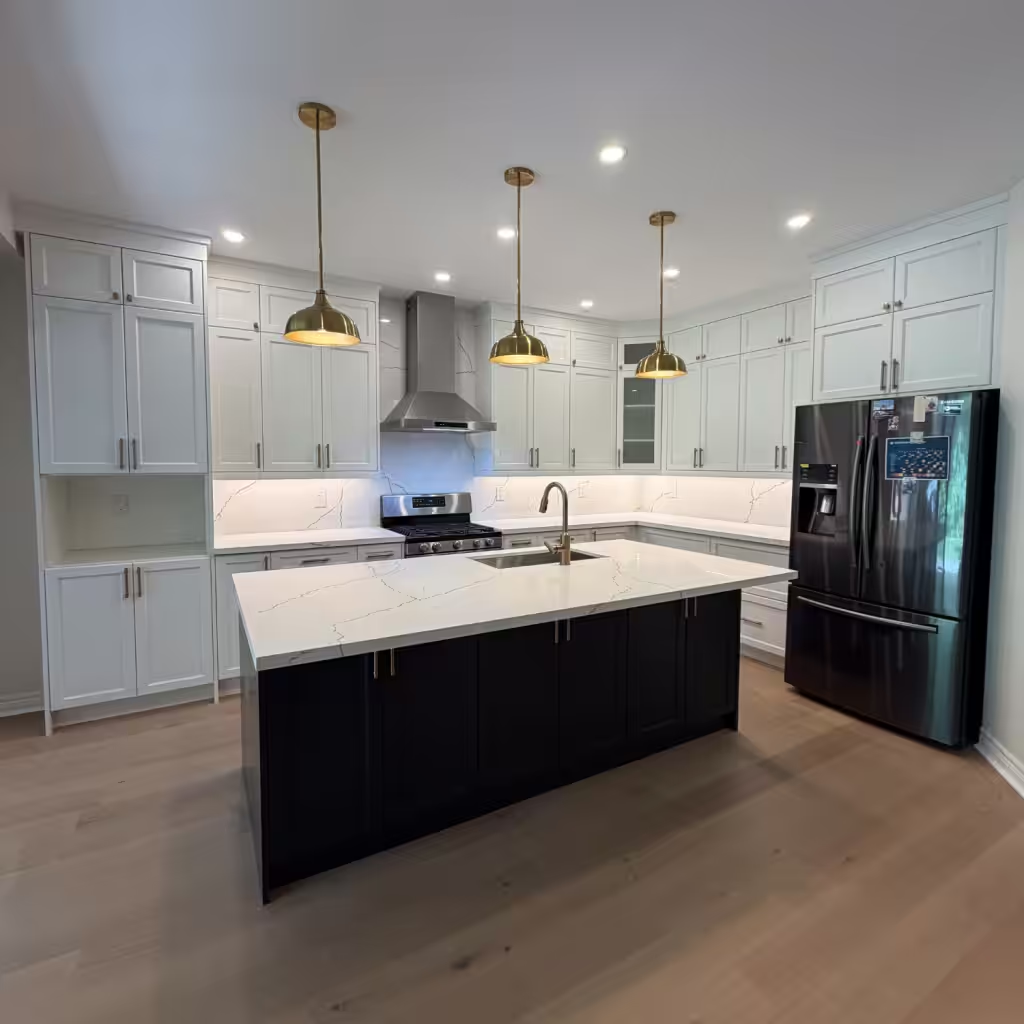
A complete kitchen renovation means demolition, any framing or structural change, plumbing and electrical, cabinetry, countertops, backsplash, flooring, lighting, paint and final installation — each depending on the one before it. The expensive mistakes almost always happen in the handovers, not inside any single trade: a cabinet run that does not suit where the electrician put the outlets, a counter templated before the boxes were level, flooring laid to a layout that then changed. That is the real argument for one company holding the whole sequence rather than you coordinating five.
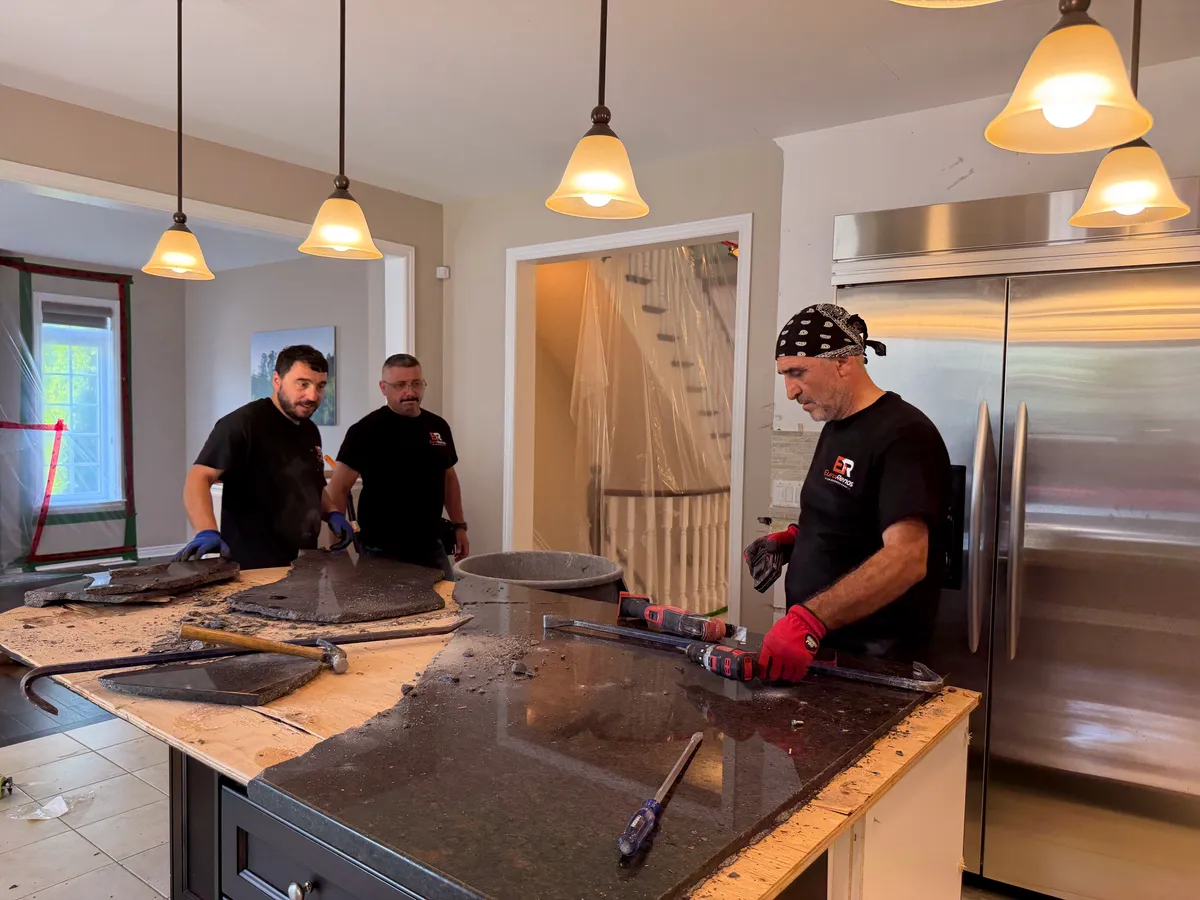
Demolition first, then framing and structural work, then plumbing and electrical roughed in while the walls are still open — and inspected at that point, because once it is closed up nobody can see it. Cabinets go in next. Only once the cabinets are installed and levelled does anyone template the countertops. Templating from drawings instead of from the boxes actually in the room is the most common reason a counter arrives that does not sit right, and it is a mistake that costs weeks to undo. Backsplash follows the counters, then flooring, trim and paint, then appliances and the walkthrough.
Keeping the sink, stove and fridge roughly where they are is dramatically cheaper and faster than moving them, and it is the single biggest lever on both price and schedule. Moving a sink to a different wall means running drain across the floor joists rather than along them — several times the work, and often opening the ceiling below. It can absolutely be worth it: a kitchen you will stand in for fifteen years should not be arranged around where a pipe happened to run in 1985. But it should be a decision you make deliberately at the design stage, not one that surfaces halfway through demolition.
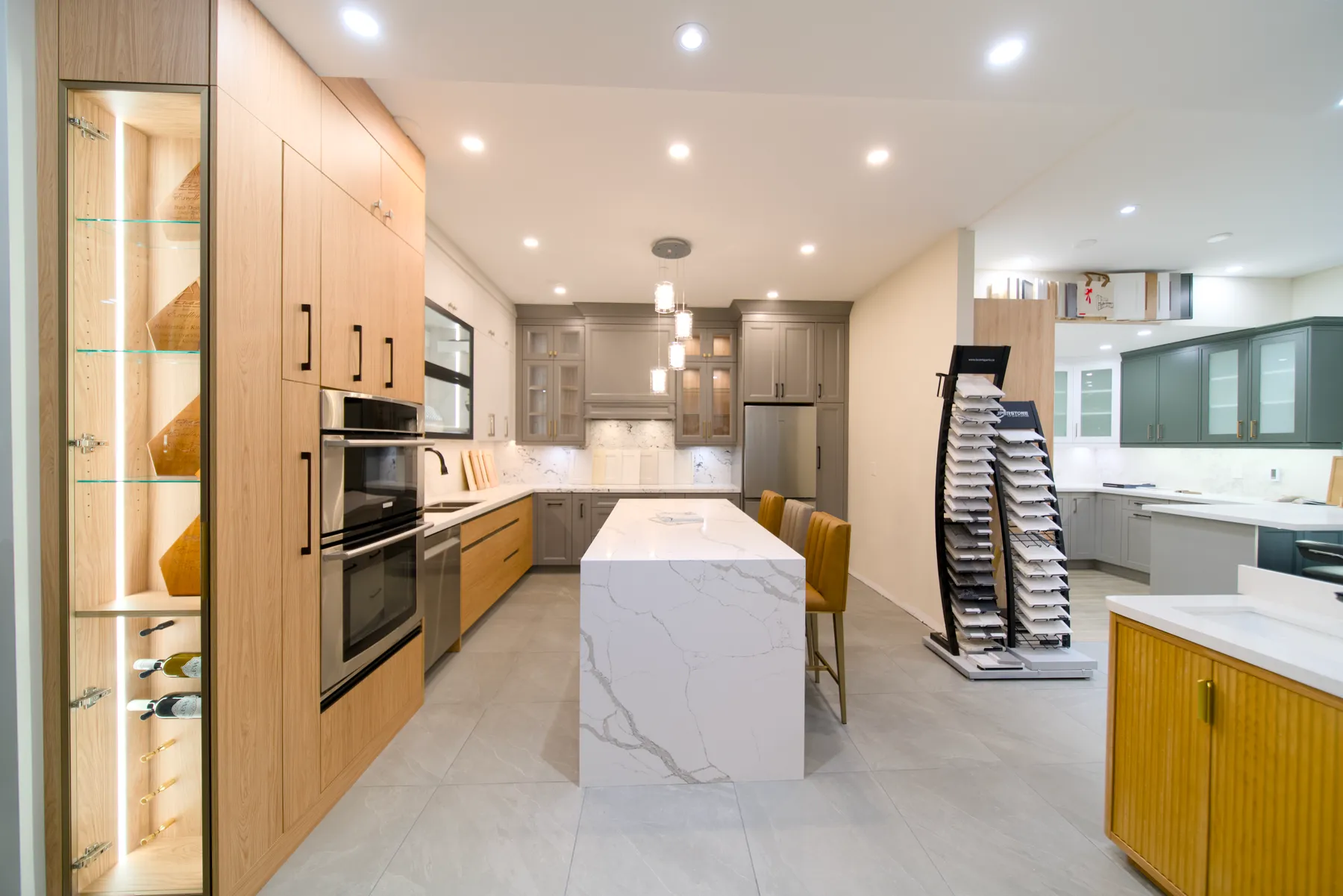
Cabinets are usually the largest line in a kitchen and the part you physically touch every day, so it is worth knowing what you are comparing: how the box is built, whether the hinges and drawer runners are decent, and what the doors are actually made of rather than what they look like in a photograph. We manufacture ours at our own facility in Woodbridge and you can see the finishes full size at the Mississauga showroom. The practical value of that is not only price — the company that builds the cabinets is the company that installs them and the company that warranties them, so if a door needs adjusting in two years there is no supplier to point at.
A like-for-like replacement generally does not need a building permit. Structural changes, moving a plumbing stack and new electrical circuits do, and where a permit applies it adds both cost and time for scheduling the inspection. Separately from that, an ESA inspection is required whenever the electrical is modified — which in practice covers nearly every kitchen renovation, because new circuits for the range, the dishwasher and the counter receptacles are almost always part of the job. Any renovator who tells you a full kitchen never involves ESA is worth a second question.
Cabinets take two to four weeks to build, depending on the scope and the materials you choose, so most of the waiting happens before anyone arrives. Once they are in, demolition through to cabinets, plumbing, electrical and countertops installed runs one to two weeks — three to four if you are renovating more than the kitchen. You can usually stay in the house, but you will be without a sink and a stove for most of that, so it is worth setting up a kettle, a microwave and a washing-up spot somewhere else before the first day. Dust is the thing people underestimate — ask any renovator you are considering how they contain it and how they leave the site each evening, and compare the answers.
Three things, consistently. A written scope agreed before anything is demolished, so what is included is a document rather than a memory of a conversation. One company accountable for the whole sequence, so a delay in one trade is their problem to solve and not yours to chase. And a warranty from whoever actually did the work — not from a supplier you have never met. None of that is glamorous, and all of it is what the difference comes down to a year later.